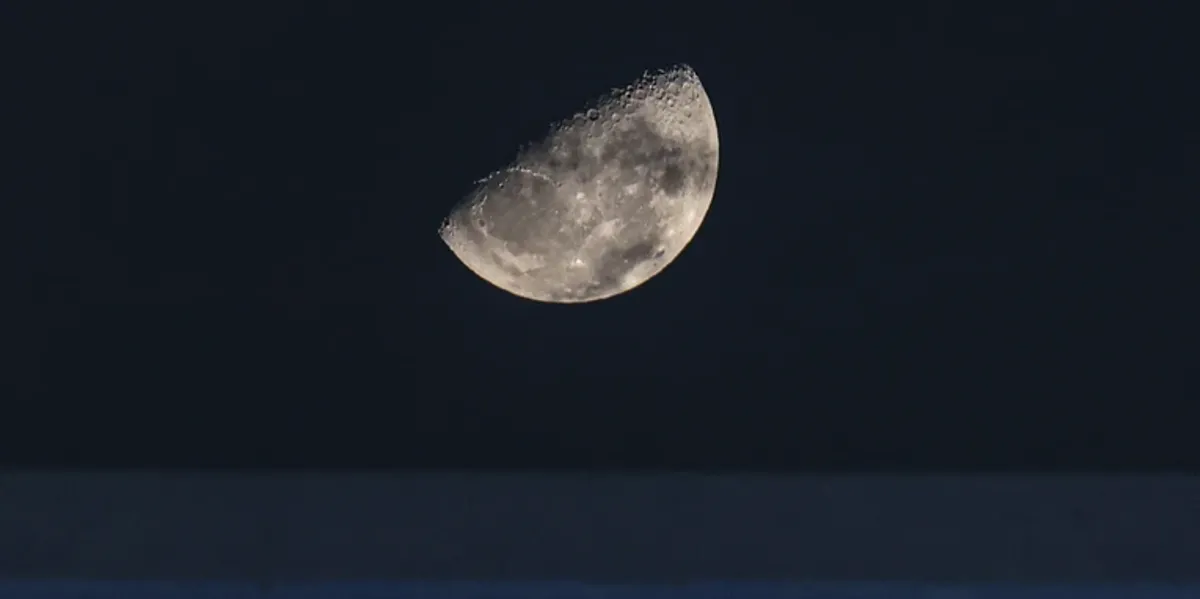
The Moon is much more than just a decoration in the night sky. If it were to suddenly disappear, the consequences for Earth would be huge – from tides to climate and ecosystems. For billions of years, the Moon has orbited Earth at an average distance of about 384,400 kilometers, influencing life on our planet more than many people realize.
On the occasion of International Moon Day, which is celebrated every year on July 20, the German news agency dpa analyzed the question: What would happen if the Moon suddenly disappeared? NASA’s answer is clear: Earth would be a completely different place. Some consequences would be felt immediately, such as darker nights and much weaker tides.
Other changes, such as the instability of the Earth’s axis or changes in its rotation, would appear over very long periods of time. The Moon is the Earth’s only natural satellite. Although life cannot exist on the Moon itself, as it has no atmosphere, it plays a crucial role in maintaining the conditions that make life possible on Earth, writes diewelt .
The Moon’s gravitational pull acts as a stabilizer for the Earth’s axis. This axis is currently tilted about 23.5 degrees relative to the Earth’s orbit around the Sun, and it is this tilt that makes possible the different seasons in the northern and southern hemispheres. If the Moon were to disappear, the tilt of the Earth’s axis would become much less stable.
According to calculations by the Royal Greenwich Observatory, the Earth’s axis could wobble significantly. In the most extreme scenario, the axis could stay almost straight, causing the seasons to almost disappear. If it were tilted more in the other direction, some parts of the Earth would face much hotter summers, harsher winters, or even ice ages.
The Moon’s gravitational pull is the main cause of tides. “The Sun also influences the tides, but its influence is about half that of the Moon,” explains Martin Knapmeyer from the German Aerospace Center (DLR). This means that, without the Moon, the tides would be significantly weaker. Coastal ecosystems, which depend on this natural cycle, would be radically altered.
Many species, such as mussels, starfish, sea snails and various types of crabs, could lose their habitats. The Moon affects Earth in another way as well. Over billions of years, its gravitational pull has gradually slowed Earth’s rotation—from just a few hours in the distant past to the 24-hour day we have today.
If the Moon disappeared, the length of the day would initially not change, says Martin Knapmeyer. However, over billions of years, the Sun’s influence would further slow down Earth’s rotation, until our planet could end up always turning the same side to the Sun, just as the Moon always shows the same face to Earth.
The disappearance of the Moon would have immediate consequences for the animal world as well. Many nocturnal species navigate by moonlight or have adapted their hunting and reproduction to the lunar cycle. Without the Moon, nights would be much darker. Some predators would have a harder time finding prey, while other species could take advantage of the greater darkness.
These changes could significantly transform existing ecosystems. /Telegraph